
SEO, AEO & GEO: The Complete Guide to the Future of Digital Visibility (2026)
The “blue link” era is officially in the rearview mirror. In 2026, the internet has evolved from a massive library of documents into a living, breathing network of answers.
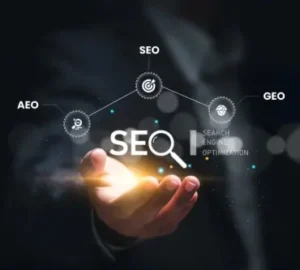
If your digital strategy is still obsessed with snagging the #1 spot on a search results page, you’re chasing a ghost. Today’s users don’t want a list of websites to browse; they want a synthesized solution delivered instantly by their AI assistant, their car, or their smart glasses. To remain visible, brands must now master the Visibility Trinity: the technical precision of SEO, the instant utility of AEO, and the authoritative citations of GEO.
Welcome to the future of discovery where being “found” is no longer enough; you have to be the answer.
1. The Definitions: Understanding the Three Pillars
While they share the same goal visibility each serves a different user journey and technology stack.
SEO (Search Engine Optimization)
- The Goal: Ranking high in traditional search results (Google, Bing).
- Focus: Driving clicks and traffic to your website.
- Key Driver: Keywords, backlinks, and technical site health.
- 2026 Context: SEO is the foundational layer. It provides the “raw data” that AI engines crawl.
AEO (Answer Engine Optimization)
- The Goal: Being the “one true answer” for voice assistants (Alexa, Siri) and featured snippets.
- Focus: Immediate problem solving, often resulting in “zero-click” searches.
- Key Driver: Structured data (Schema), FAQ formats, and conversational language.
- 2026 Context: AEO is for the “on-the-go” user who needs a fact, a price, or a step-by-step guide without visiting a site.
GEO (Generative Engine Optimization)
- The Goal: Being cited as a source within AI-generated summaries (ChatGPT, Perplexity, Gemini).
- Focus: Authority and citation. It’s not about being the only answer, but the trusted source the AI uses to build its answer.
- Key Driver: Statistics, expert quotes, entity-based optimization, and “citable” passages.
- 2026 Context: GEO ensures that when an AI explains a topic, it says, “According to [Your Brand]…”
3. SEO in 2026: The Foundation of Discovery
Traditional SEO isn’t dead; it has simply evolved into a technical prerequisite. In 2026, Google’s algorithms are less about keyword density and more about E-E-A-T (Experience, Expertise, Authoritativeness, and Trustworthiness).
- Topical Authority: You cannot rank for a single keyword anymore. You must own a “Topic Cluster.” If you sell “Cloud Security,” you need content covering every sub-niche from “Zero Trust” to “Edge Computing.”
- Core Web Vitals 3.0: Site speed is no longer a “bonus” it’s a barrier to entry. AI crawlers favor lightweight, fast-loading pages that they can parse in milliseconds.
- Human-Centric Content: As the web becomes flooded with AI-generated “slop,” search engines are rewarding content that shows clear signs of human experience (original photos, first-person case studies, and unique opinions).
4. AEO: Winning the “Zero-Click” Era
By 2026, nearly 60% of searches end without a click. Users get their answer directly on the Search Engine Results Page (SERP). AEO is the art of ensuring that your content is the source of that answer.
Tactics for AEO Success:
- The “Answer First” Format: Structure your paragraphs with a 40–60 word direct answer at the very top, followed by the “why” and “how.”
- Schema Markup is Non-Negotiable: Use JSON-LD to explicitly tell bots what your content is. If it’s a recipe, use Recipe schema. If it’s a tutorial, use HowTo.
- Voice Search Optimization: People speak in full sentences. Instead of “Weather London,” they ask, “What’s the weather like in London today?” Use long-tail, conversational headers (H2, H3) that mirror these questions.
5. GEO: The New Frontier of AI Citations
GEO is the newest and most complex layer. Generative engines (like Perplexity or ChatGPT with Search) don’t just find a link; they “read” the internet and write a report. To be included, your content must be citable.
How to Optimize for Generative Engines:
- Include Hard Data: AI models love numbers. Posts containing original statistics or data tables have a 40% higher chance of being cited in AI summaries.
- Be an Entity, Not a Keyword: AI thinks in “entities” (people, brands, places). Ensure your brand is mentioned across the web—not just on your site. Mentions on Reddit, Quora, and niche industry forums act as “votes of confidence” for AI models.
- The “llms.txt” File: Just as we have robots.txt for search engines, 2026 best practices include an llms.txt file to provide a clear, text-only roadmap specifically for Large Language Model crawlers.
6. Creating a Unified 2026 Strategy
You shouldn’t choose between these three. You need a “stackable” approach where one piece of content serves all three purposes.
The “Stackable Content” Workflow:
- The Core (SEO): Create a 1,500-word deep-dive on a relevant industry problem. Ensure it has a fast load time and high-quality backlinks.
- The Snippet (AEO): Within that post, include a “Key Takeaways” section and an “FAQ” at the bottom with schema markup to capture voice search and snippets.
- The Citation (GEO): Embed one original graphic and three proprietary data points. Ensure your author bio proves “Expertise” to satisfy the AI’s need for a trusted source.
7. The Future: Measuring Success Beyond Clicks
In 2026, the traditional Google Search Console “Click” metric is only half the story. To measure true digital visibility, you must track:
- Share of Model (SoM): How often is your brand mentioned in ChatGPT or Gemini responses for your industry?
- Citation Volume: How many AI summaries link back to you as a footnote?
- Brand Sentiment in AI: When asked about your product category, does the AI recommend you as a “top-tier” or “budget” option?
Conclusion: Adapt or Fade
The era of “building a website and waiting for traffic” is over. Digital visibility in 2026 requires an active presence across traditional search, answer boxes, and generative AI conversations. By balancing the technical foundation of SEO, the direct utility of AEO, and the authoritative citations of GEO, you ensure your brand isn’t just a result it’s the answer.
Lorem ipsum dolor sit amet, consectetur adipiscing elit. Ut elit tellus, luctus nec ullamcorper mattis, pulvinar dapibus leo.